How this content was verified
Institutional content drawn from identified sources. We separate the general information from individual guidance and do not have a consultation, medical statement or limitation as an automatic guarantee.
Evidence behind the guide
independently consulted sources. The inclusion of them does not involve affiliation or collateral to CAMED.
When a person wants a "medical support," they can be thinking about very different documents. A certificate, a medical statement of attendance, a prescription and a copy of the medical history do not prove the same. To merge them can explain more information, frustrate a procedure or lead them to believe that an authorisation that the document never gave.
The useful question is not simply “Will I receive a document?”, but “What fact do I need to prove, to whom, for what purpose, and what document can the person responsible for my care truthfully issue?”
1. Medical certificate
Act 23 of 1981 defines a medical certificate as a document intended to atprove his or her birth, state of health, prescribed treatment or death. His issue entails legal and moral liability for his doctor. The text should be clear, precise and strictly truthful and should indicate the end for which it was issued.
Decree 1171 of 1997 lays down that a certificate concerning the status of health, treatment or medical conduct should include at least place and date, recipient, status or treatment that is attested, patient identification, aim, name of doctor, registration or professional card and signature.
2. record of attendance or assistance
“Record of attendance” is a practical term for a document confirming that an interaction took place, including its date, format or professional. We did not find a single national template with that name for all consultations in the general rules reviewed. Its contents and availability depend on what actually occurred, the person responsible for care and the requested purpose.
A simple medical statement does not automatically prove diagnosis, aptitude, disability, treatment or prescription. If it includes statements about health status, treatment or medical activity, its substance can bring it closer to the medical certificate and should respect the necessary requirements of truth, accuracy, authority and liability.
3. Medical prescription or prescription
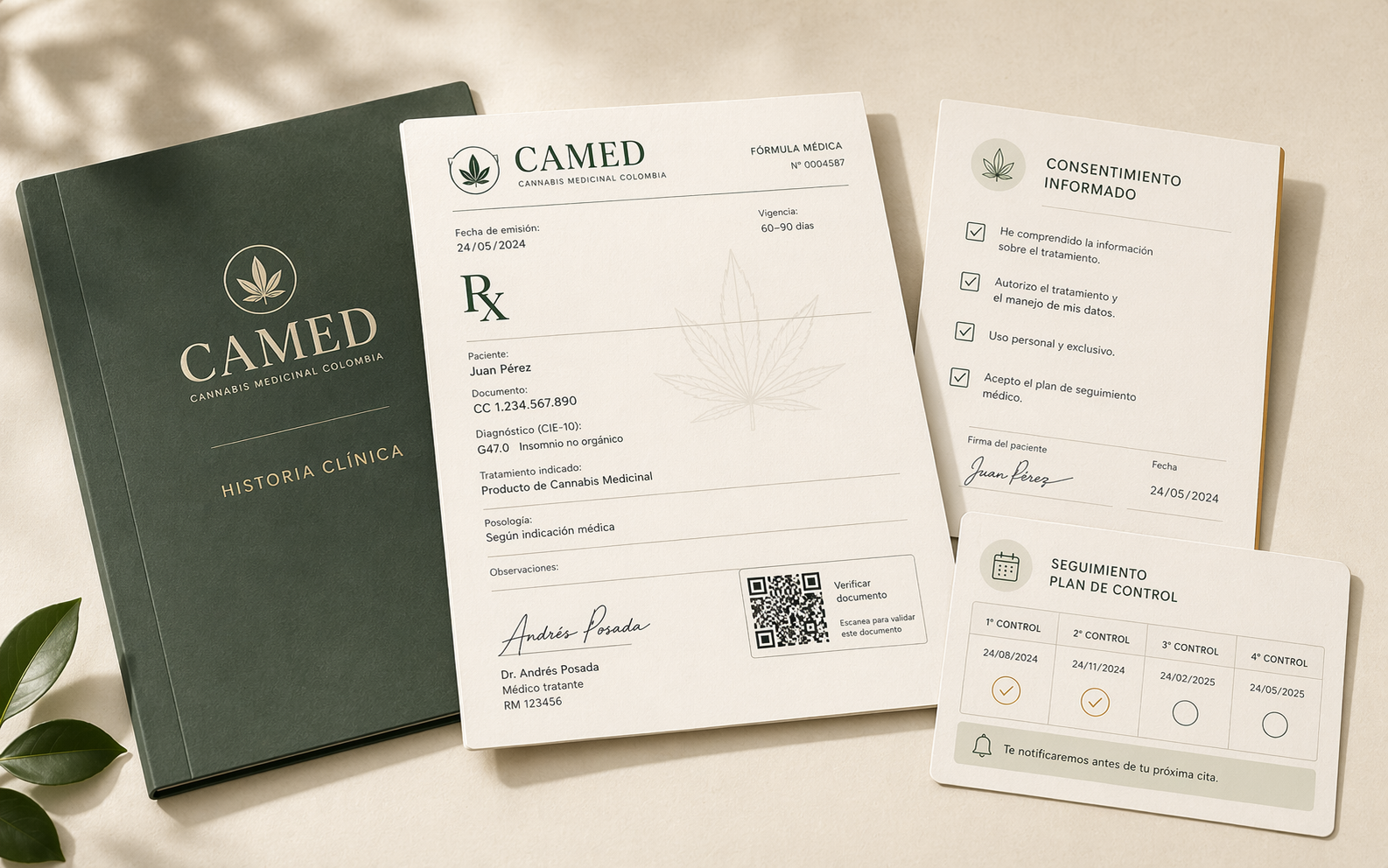
The prescription materializes a therapeutic decision by a person legally authorized to prescribe. The pharmaceutical regulations require prior assessment and registration of conditions and diagnosis in clinical history. It also lays down minimum data to identify the patient, the prescriptor, the medicine and the instructions for use.
- It's not a generic attestation about the person: it contains a concrete therapeutic order.
- It should not be emitted only because the patient so requests and depends on his or her clinical judgment and his or her skills.
- In telemedicine, it can only be performed under the categories and conditions authorized by Resolution 2654.
- Special monitoring medicines are subject to additional requirements, including an official prescription as appropriate.
- The validity, composition and other fields matter for the dispensing and an incomplete photo or an altered document may be of no use.
4. Medical history
The medical record is the mandatory chronological record of health conditions, medical acts and procedures performed by the healthcare team. It is a private, confidential document. Its purpose is to document care and support continuity, rather than to persuade a third party.
Law 1751 of 2015 recognizes the patient’s right to access their entire medical record free of charge and obtain a copy. Law 2015 of 2020 adds that electronic medical records must be provided electronically, free of charge, promptly and in full. Disclosure to third parties remains subject to the patient’s authorization and legal exceptions.
Rapid Comparison
- Medical certificate: attests a true clinical event or a medical act for an identified purpose.
- A constant care: normally attests to an interaction and his name does not give him additional clinical or legal effect.
- prescription or prescription: orders a specific medicine or treatment after an assessment and under the responsibility of the prescriptor.
- Clinical history: it gathers a confidential care register and may contain diagnoses, decisions, recommendations and annexes but it's not a general permission.
- Abstract of care: synthesizes selected information and does not necessarily replace complete copies of the story and have a certificate.
What should you apply for?
- 1He asked the recipient entity what fact it needed to atcredit and what rule or procedure defined the requirement.
- 2Avoid giving complete medical history if a less invasive document is sufficient and contains sensitive and reserved information.
- 3It explain to the professional the exact purpose, without suggesting false information or a predetermined conclusion.
- 4It verifies that the document identifies those who issue them, have a date, are legible and effectively appropriate to care.
- 5Keep the digital original and do not modify signatures, dates, diagnoses, quantity or instructions.
In medical cannabis, the difference is especially important
There is no universal “cannabis certificate” in the official regulations reviewed. A cannabinoid prescription, when the professional considers it indicated and it meets regulatory requirements, documents a treatment decision. A certificate may truthfully describe a health condition or treatment for a specific purpose. The medical record documents the care process. None of these documents, by itself, grants a general licence to possess, grow, sell, transport or cross borders with cannabis.
verifiable sources
Consulted external links to prepare and update this content.
- 01Act 23 of 1981 - Medical ethics, limitation, history and certificates (Civil Service)Official source · funcionpublica.gov.co
- 02Decree 1171 of 1997 — contents of a medical certificate (Función Pública)Official source · funcionpublica.gov.co
- 03Resolution 1995 of 1999 - Medical History Management (Ministry of Health)Official source · minsalud.gov.co
- 04Act 1751 of 2015 - patient rights and occupational autonomy (SUIN-Juriscol)Official source · suin-juriscol.gov.co
- 05Act 2015 of 2020 - electronic and interoperable clinical history (SUIN-Juriscol)Official source · suin-juriscol.gov.co
- 06Decree 2200 of 2005 - characteristics and contents of the prescription (SUIN-Juriscol)Official source · suin-juriscol.gov.co
- 07Resolution 2654 of 2019 - Telecounselling and limitation by telemedicine (Ministry of Health)Official source · minsalud.gov.co
Institutional content of CAMED. Consultation our editorial policy and evidence methodology.